Psalm 23: “baa! baa! baa!”

November 13, 2018

“The Lord is my Shepherd…”  (Psalm 23:1)

Can you declare the first five words of this great Shepherd Psalm as a personal confession of faith? Can you personally confess with authentic faith, “the Lord is my Shepherd?”

People often touch me as they describe the way the Lord came into their lives, made them lie down and say, “baa!” I am frequently concerned, however, when I don’t hear how that relationship is working in their lives today.

One of David’s most remarkable declarations in this psalm is that the blessings provided by his Shepherd-God are in place ‘all the days of my life.’ Be sure to make the observation that David’s great profession of faith is not, “The Lord was my Shepherd,” but “The Lord is my Shepherd.”

When we confess, “The Lord is my Shepherd,” we are also confessing that we are God’s sheep. It’s not flattering when God tells us we are like sheep. Sheep are so ignorant they are completely helpless and hopeless without their shepherd. Yet, the Word of God clearly tells us God wants us to agree with this appraisal and confess, “All we like sheep have gone astray; we have turned everyone to his own way.” (Isaiah 53:6)

Many years ago I was out of bed at an early hour. When my wife Ginny woke up, she asked why I was getting up at 4:30a.m. I told her what I had read during my devotions: “When you wake up, get up, and when you get up, do something for God and for His lambs!”

She responded, “baa! baa! baa!” She was reminding me of something busy pastors often forget – that she and our five children are also God’s lambs.

Psalm 23 is filled with sheep talk that God wants to hear every one of us say, “baa!”

Dick Woodward, from Psalm 23 Sheep Talk


An Inspired Art Gallery (of Faith)

November 9, 2018

“So the Word became human and made his home among us.” (John 1:14)

The Gospel of John is like an inspired art gallery. Every chapter is like a room in that gallery with beautiful portraits of Jesus Christ hanging on the walls. In the first room, the portrait is that of Jesus as the Word that became human to make His home among us.

If you want to communicate a great idea wrap it in a person. God does that all through the Bible. God communicates the concept of faith by wrapping it in the person of Abraham. God tells us what grace is by wrapping that beautiful concept in the person of Jacob.

What does it mean when we are told that Jesus is the Word? A word is the vehicle of a thought. When I want to communicate thoughts that are in my mind to your mind I use words as vehicles of my thoughts. God had ‘Thought’ that God wanted to express to this world. Jesus is like a beautiful comprehensive Word that expresses the Thought of God to this world – and to you and me.

Our loving Heavenly Father decided that an inspired written Word was not enough. God wanted us to see God’s expressed thought in human flesh and blood. God therefore became human and made God’s home with us as Jesus so that we can see and experience God’s expressed thought toward us.

The Word not only made His home among us – Jesus wants to make His home in us. If He has done that for you, what great ideas does Jesus want to communicate to others by wrapping them in your life?

Dick Woodward, 10 November 2011


Spiritual Values: God First

November 6, 2018

“…but you seek first the kingdom of God and His righteousness and all these things will come to you as a matter of course.” (Matthew 6:33 J. B. Philips translation)

The message of the entire Bible can be summed up in two words: “God First.” Over and over the bottom-line truth in a Psalm, the life of a Bible character, a parable, a metaphor, and a teaching of Jesus comes down to this simple concept: “God First.”

That is not easy. In fact, it is impossible without the Holy Spirit. (1Corinthians 12:3)

I was blessed to have a godly mother who often said to me: “If Jesus Christ is anything to you, then Jesus Christ is everything to you. Because until Jesus Christ is everything to you, Dick, He isn’t really anything to you.”

As I carefully studied the values of Jesus Christ, I realized that my mother had the Lord’s support when she brought my profession of faith to a verdict in this way.

Matthew 6:33 is the conclusion of a study given by Jesus regarding values. He taught that our hearts are where our treasures are. He also taught us where our treasures and our hearts ought to be by challenging us with questions like: “Where is your heart? What are your treasures? What is your life? What is your body?” and “Who is your master?”

The conclusion to this treatise on values is the declaration to seek God first. Think of a target with a bulls-eye surrounded by ten or twelve circles. According to Jesus, the bulls-eye of our priority target should be that our first value is God. We are to put God first. If we do that we have Christ’s promise that God will bless us with whatever else we need.

When we think about our values these two words should immediately surface in our hearts and minds: “God First.”

Dick Woodward, 09 November 2010


God’s Good (vs. Our Good)

November 2, 2018

“And we know that all things work together for good to those who love God, to those who are called according to His purpose.” (Romans 8:28)

As I look back over my life since I was born in 1930, and born again in 1949, this verse sums up my entire walk of faith and ministry. According to the J. B. Philips translation, God fits into a pattern for good everything that happens to those who love God and are called according to God’s plan. I like this because the implication is there may not be anything good about many of the things that happen to us.  But if we meet two prerequisites – if we love God and are called according to His plan – our loving God will fit into a pattern for good all the events of our lives.

Before we personally apply the great promise of this verse we must meet those two prerequisites. The first is that we love God.  It isn’t easy to love God. The Apostle John asked us how we can love God we cannot see. (1 John 4) We can’t hug a Spirit.  Jesus told us that if we love Him we must keep His commandments.  According to Romans 8:28 quoted above, we show we love God by the second prerequisite: being called according to God’s plan.

We are so self-centered we are quick to assume that the good into which God fits all the events of our lives means our good.  However, when we understand what it means to love God the only good that will interest us will be God’s good.

Dick Woodward, 05 November 2010


25 October: Dick Woodward Standing Tall

October 25, 2018

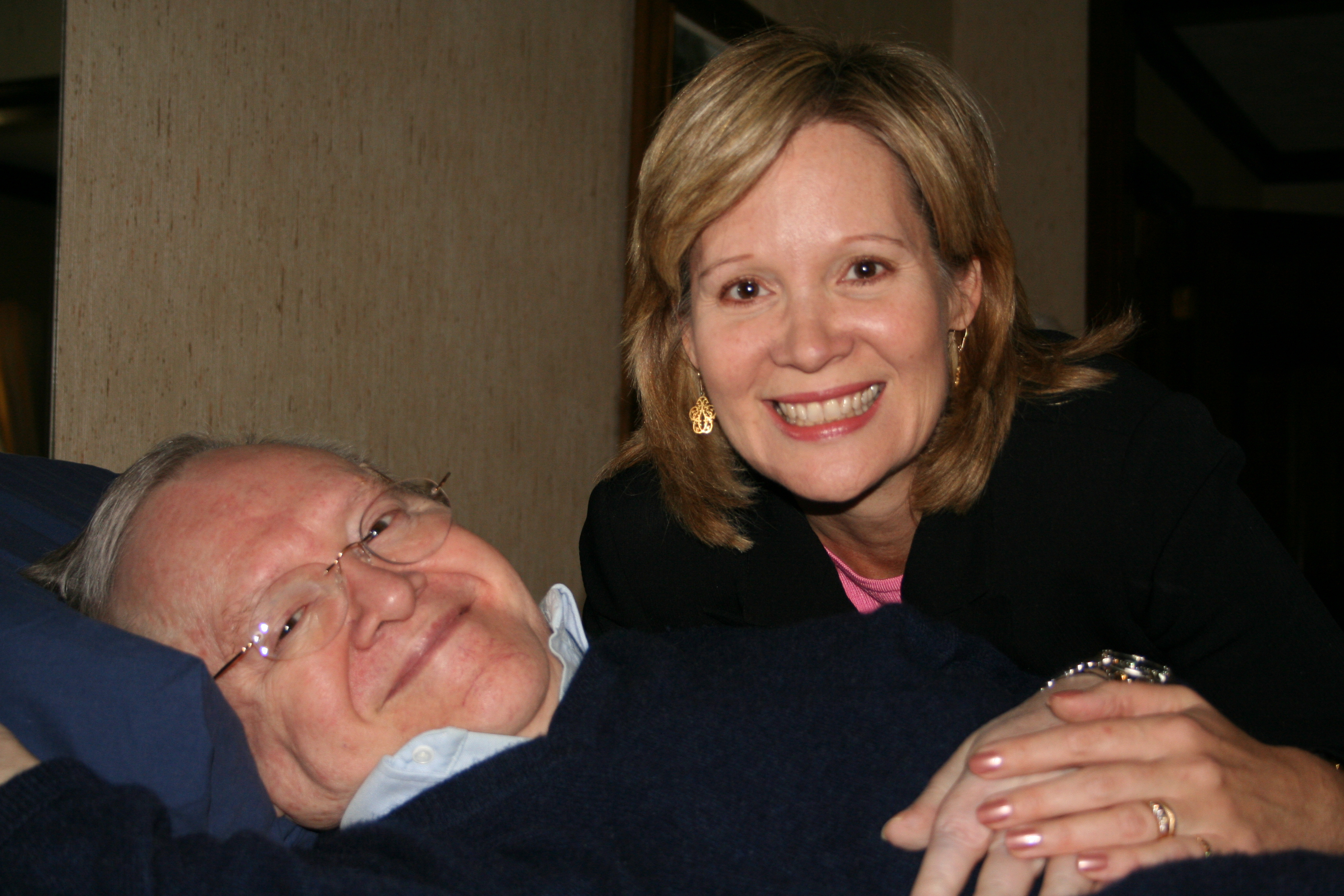
October 25th is Dick Woodward’s birthday (he would have turned 88 today.)The fact that he was 83 when he died as a bedfast quadriplegic in 2014 is miraculous. But everyone who knew Dick Woodward can probably still hear his voice saying, “I can’t, but God can… I didn’t but God did.” (In other words, even when Papa couldn’t do anything but nod his head, God did miraculous things in and through him.) Today in honor of his birthday, here is a poem my sister, Cindy, wrote for him on his 77th birthday. It’s comforting to know that after 28 years as a quadriplegic, today in Heaven he is standing tall in the eternal love of Jesus.

STANDING TALL

DAD

How do we tell the story of your extraordinary life?
Your background conditions would have predicted only strife.
 
Growing up in the Depression with barely enough to eat,
Your father working day and night just to make ends meet.
Overshadowed by your siblings—the seventh child of eleven,
But at the age of nineteen sought out by the God of heaven.
 
Such a change in direction,
Indescribable new affection!
ANYWHERE, ANYPLACE, ANYTIME,
Was your commitment to your Savior divine.
 
A gift for speaking and engaging wayward souls,
Making the Word simple in order to make men whole.
Many years spent preaching to empty pews,
When suddenly the wind of the Spirit blew.
 
Then came along the Mildred Alexander show,
And a TV audience with a hunger to know.
Many folks tuned in to discover
The Mini-Bible College from cover to cover.
 
So much spiritual success,
But one day really put to the test,
A crippling illness took away your mobility,
Yet grace was greater than your disability.
 
Immeasurable fruit on seven continents,
Broadcasts, booklets, “God-pods” and Internet.
“Unexplained happiness” for all to see,
“I can’t, but He can”—your secret remedy.
 
So how do we tell your story, Dad?
By telling of the Savior you’ve had.
Jesus Christ is your all in all,
And by His grace you’re STANDING TALL!

Cindy Woodward Kranich 10/25/2007


Accessing God’s Amazing Grace

October 23, 2018

“…we have gained access by faith into this grace in which we now stand… Not only that, but we rejoice in our sufferings, knowing that suffering produces endurance, and endurance produces character, and character produces hope, and hope does not disappoint us, because God’s love has been poured into our hearts through the Holy Spirit.” (Romans 5:2-5)

Paul writes that God has given us access, by faith, to a quality of grace that makes it possible for us to stand for Christ in this world and live our lives glorifying God. Then he writes we should rejoice in our sufferings, because God sometimes uses suffering to force us to access grace.

There are levels and degrees of suffering we simply cannot endure without the grace of God. When our suffering drives us beyond the limits of any human resources we have within us, these times of severe testing become God’s opportunity to provide and prove grace to us.

A devout hymn writer expressed this truth this way:

“When we come to the end of our store of endurance.
When our strength has failed and the day is half done.
When we have exhausted our hoarded resources
Our Father’s full giving has only begun.

“His love has no limit. His grace has no measure.
His power has no boundary known unto men.
For out of His infinite wisdom and mercy
He gives and He gives and He gives yet again.”

[“His Love Has No Limit” by Annie Johnson Flint (1866-1932)]

Are you willing to let problems you cannot solve and suffering you cannot endure drive you to access God’s amazing grace today?

Dick Woodward, 23 October 2009


GOD’S AMAZING (DAILY) GRACE

October 19, 2018

“God is able to make all grace abound toward you, that you, always having all sufficiency in all things, might abound unto every good work.” (II Corinthians 9:8)

This is the most emphatic verse in the Bible about God’s grace. According to Paul, God is able to make all grace (not just a little bit of grace), abound (not just trickle), toward you (not just your pastor and missionaries, but toward you), that you (he repeats you for emphasis), always (not just sometimes), having all sufficiency (not just some sufficiency), in all things (not just some things), may abound (not just limp along), unto every good work (not just some good works.)

All grace, abounding, always, all of you, all sufficiency, all things, always, abounding in all the good works God wants to do through you! The New Testament church turned the world right side up because they believed and experienced the truth Paul proclaimed in this extraordinary verse about God’s amazing grace.

The challenge for you and me is to believe in, and access, this grace. The grace of God is not only the undeserved favor of God we receive when our sins are forgiven – grace is the power God wants to pour in us as we live for and serve God. The word “charis” is the Greek word for grace. The word “charisma” or “charismata” is the Greek word that describes the grace God dispenses. It is impossible to be a disciple of Jesus Christ without this charismatic grace of God.

The great challenge is to access this grace on a daily basis. Do you believe God is able to make all grace abound toward you today? That you, always, having all sufficiency in all things can abound unto every good work God wants to do through you?

Dick Woodward, 20 October 2009


Who is the Greatest?

October 16, 2018

“He must increase, but I must decrease.” (John 3:30)

Who was the greatest prophet who ever lived? According to Jesus the answer is John the Baptist. (Luke 7:28, Matthew 11:11) After studying the Scripture for six decades I find that answer intriguing because very little space in the Bible records John the Baptist’s life and ministry.

Meditating on the Scriptures that describe him, I have come to the conclusion that at least one key to his greatness is that he accepted the limits of his limitations and the responsibility for his abilities.

As we attempt to discover who we are and what God wants to do through our lives it is a good rule of thumb to accept the limits of our limitations and the responsibility for our abilities.  When a degenerative disease of the spinal cord took away my physical abilities (26 years ago), it was vital for me to accept my increasing limitations and continue to be responsible for my abilities.

After the first two years of crippling illness when acceptance came, it was so profound it felt like a form of inner healing. Using speech recognition software on my computer I received the grace to write about ten thousand pages of what we call The Mini Bible College. These 782 studies of the Bible have been translated into 28 languages in 60 countries.*

It fills me with grateful worship to realize that the formula for greatness I learned from John the Baptist guided me to the most important work I have done for Jesus Christ.

Are you willing to accept the limits of your limitations and the responsibility for your abilities?

Dick Woodward, 16 October 2012

*Editor’s Note: As of October 2018, the Mini Bible College has been translated into 48 languages (with 12 more in production) impacting 84 countries. Thanks be to God and the ongoing work of International Cooperating Ministries.


Jonah: God’s Love for ALL PEOPLE

October 9, 2018

“…for I know that you are a gracious God and merciful, slow to anger, and abounding in steadfast love, and ready to relent from punishing… Then the Lord said, “Is it right for you to be angry?”  (Jonah 4:2-4)

As a prophet, one of Jonah’s functions was to remove obstacles that were blocking the work of God in the world. Do you see the obstacle in Jonah’s story? Jonah’s prejudice. As we reflect upon the prejudice of Jonah, we should ask ourselves if prejudice in our hearts is blocking the love God wants to express through us to hurting people in our world.

The real message of Jonah is that God loves people. God loves all people! The love of God is a bottom line truth we find in the inspired Scriptures from Genesis to Revelation.

Can you see why I believe the real message of the Book of Jonah has little to do with whales swallowing people? Refuse to get sidetracked. When you come to the book of Jonah looking for truth, you will find at the heart of this book a loving God Who values people and longs to draw all men, women and children to God.

The message of Jonah is that God earnestly desires to express unconditional love and grace through God’s faithful servants. The people of God, like you and me, are designed to be the vehicles of God’s love, grace and salvation. When the people of God are prejudiced, the very people God designed to be the vessels, models and channels of God’s salvation become obstacles that block the love and salvation work of God in this world.

If God loves Ninevites, and the people of God hate Ninevites, how can God express God’s love and salvation for all people if God’s people are hung up on their prejudices?

Dick Woodward, from Jonah Coming & Going: True Confessions of a Prophet


Showcase: God’s Strength in Our Weakness

October 5, 2018

“…When I am weak, then I am strong.” (2 Corinthians 12:10)

The Apostle Paul opens a biographical window into his life when he tells us about what he calls his “thorn in the flesh.” He explains that he had many supernatural spiritual experiences, but to keep him humble God gave him this “thorn.” Paul asked God three times to take it away. Even though he had an extraordinary ministry that brought healing to many, three times God’s response was essentially: “No! But My grace will be with you, and that is all you need to cope with the challenge of your thorn.”

Although we’re not exactly certain what Paul’s “thorn” was, he wrote to the Galatians that when he first visited his eyes were so hideous it made them want to vomit and say that if they could, they would take the eyes out of their own heads and place them in his. The book of Acts reports that at that time Paul’s physician Luke joined him so he could treat him. This “thorn” was also accompanied with severe weakness. Paul mentions weakness so much in his writings we know that throughout his extraordinary ministry he had to cope with extreme chronic fatigue.

Paul explains that his physical weakness was a showcase in which God could exhibit God’s supernatural strength. In the Living Bible Paraphrase of this chapter God tells Paul, “My strength looks good on weak people.” And Paul confesses, “The less I have the more I depend on Him.” He summarizes all this: “When I am weak, then I am strong.”

Will you let your weakness showcase God’s strength and grace today?

Dick Woodward, 04 October 2011